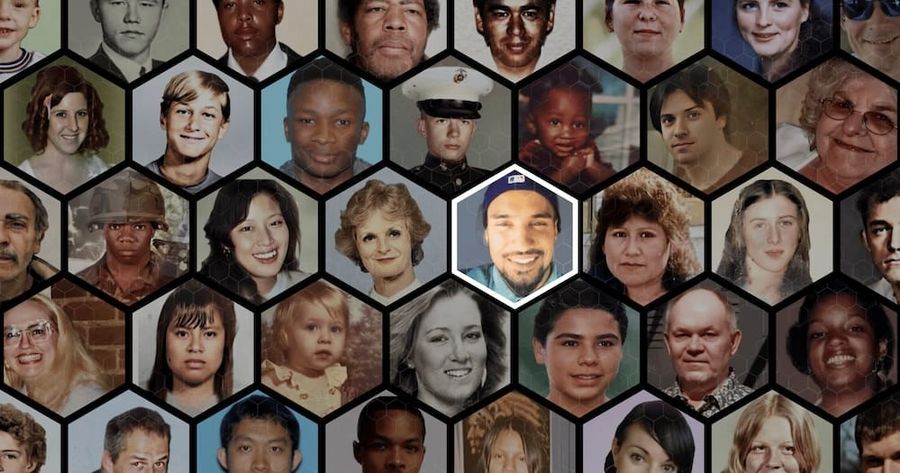
Forensic genetic genealogy has greatly improved what is possible in human identification. It has restored names to unidentified people, generated leads in investigations that have been dormant for decades and delivered answers to families who had begun to believe that answers might never come.
We recognized early that forensic genetic genealogy would require much more than access to genealogical records or a matching database. To make this technology reliably available for forensic investigations, the field needed an end-to-end infrastructure designed specifically for the realities of forensic evidence.
Othram was the first to operationalize an in-house forensic workflow for forensic genetic genealogy, bringing forensic DNA testing, genome sequencing, forensic matching, and genealogical research together within a coordinated, documented and transparent system. Since then, Othram has developed specialized laboratory methods and reagents for difficult and degraded forensic evidence, enhanced the search capabilities of the largest database available for forensic genetic genealogy searching, and deployed hardware and software that enables public forensic laboratories to operationalize these capabilities within their own operations.
Building scientific infrastructure also means sharing what we at Othram have learned. We publish extensively, and we make our peer-reviewed scientific research openly accessible so that all can benefit from it, scrutinize it, challenge it, reproduce it, and build upon it. Scientific progress depends on transparency and critique, particularly when the methods and the results generated will be used to support decisions involving identity, public safety, and justice.
These investments were not made simply to demonstrate that forensic genetic genealogy could solve exceptional cases. They were undertaken to transform a promising technology into reliable and transparent infrastructure capable of supporting routine investigations at scale. As that infrastructure has grown, so has our responsibility to measure how well it performs, understand where limitations remain, and ensure that its benefits can reach every community.
As recently written in The Next Great American Infrastructure Project, modern justice depends on systems capable of consistently turning scientific possibility into real outcomes. When those systems work, victims are identified, investigations move forward, and families receive answers. When they do not work, solvable cases can remain unsolved—not because the evidence holds answers, but because the infrastructure required to recover and act on that answer(s) is incomplete.
This is why Othram is thrilled to share that RTI International and Othram have received funding from the National Institute of Justice for a study titled The Effectiveness of Forensic Genetic Genealogy Techniques for Black, Indigenous, and Persons of Color.
The project will be one of the first large-scale studies to evaluate the performance of forensic genetic genealogy across a wide range of relevant population groups encountered in U.S.-based forensic investigations for human identification.
Building the infrastructure that makes cases solvable
Unlike traditional forensic DNA testing, which generally relies on a direct comparison between evidence and a known person, forensic genetic genealogy can identify distant genetic relatives of an unknown individual. Those relationships are combined with traditional genealogical research, public records, and other evidence to develop investigative leads.
This approach has helped identify human remains and missing-persons and assisted violent-crime investigations in which conventional forensic methods have stalled. In many cases that forensic genetic genealogy has assisted, the evidence contained useful information. However, the technology and infrastructure needed to recover and interpret that information simply did not exist.
Scientific infrastructure, however, is not sufficient just because a technique succeeds in individual cases. Case outcomes demonstrate what is possible, but they do not tell us how often a method will succeed, which factors are more likely to affect an outcome, or whether performance varies across populations and within context of investigative circumstances.
Investigators often decide which cases should receive advanced forensic testing based on limited information, anecdotal experience, or assumptions about the likely availability of genetic relatives. If those assumptions are incomplete, potentially solvable cases may never benefit from the technologies capable of producing an investigative lead.
A mature forensic discipline should not depend solely on intuition. It should be grounded on systematic performance testing, clearly understood limitations, and evidence that can guide decisions about when and how a technique should be used. The RTI and Othram study is intended to help establish that foundation.
Understanding performance across many populations
The project will evaluate the effectiveness of forensic genetic genealogy techniques for people identified as Black, Hispanic, Native American, mixed-ancestry, and White. It will also examine how traditional forensic ancestry assessments compare with ancestry inferred from genomic data.
Ancestry of individuals is complex, and the categories used in records, self-identification, forensic assessment, and genomic analysis do not always align and can be ambiguous. Understanding those differences may help investigators interpret ancestry information more effectively to make better-informed decisions about case strategy.
If meaningful differences are observed, the forensic community needs to understand which parts of the investigative process contribute to those differences and where scientific, genealogical, database, or operational improvements may be needed. Investigators will be better served by grounded evidence than by conjecture.
A system cannot be considered fully effective if its performance has not been evaluated across the populations it is expected to serve. According to the Black and Missing Foundation, nearly 40 percent of missing persons are persons of color despite Black persons making up only 13 percent of the population. Similarly, despite representing the smallest portion of the U.S. population, American Indians, Alaska Natives, and Native Hawaiians represent the second-highest number of reported missing persons.
These disparities make it especially important to understand whether modern human-identification tools are positioned to serve all communities that need them. Reliability, validity, and equity all require an understanding of how a method performs in the real world, with a focus on those conditions where there are gaps in the available data or surrounding infrastructure.
For more information, please contact Nikia Johnson, Principal Investigator at RTI International, at ncjohnson@rti.org, or Dr. Heather McKiernan, Co-Principal Investigator at Othram, at heather@othram.com.
This project is supported by Award number 15PNIJ-22-GG-04394-RESS, awarded by the National Institute of Justice, Office of Justice Programs, U.S. Department of Justice. The opinions, findings, and conclusions or recommendations expressed in this publication are those of the authors and do not necessarily reflect those of the Department of Justice.