For decades, forensic DNA testing has centered on a question:
“Does this person’s profile match the profile at the crime scene?”
That question has helped resolve countless investigations. But it requires having a known person’s DNA to compare against the DNA evidence, such as suspect, a victim, or a profile already present in a national DNA database. Without a candidate or a database match, an investigation can stall even when biological evidence contains valuable information.
Modern forensic genomics can now center on a different question: “Whose DNA is this?”
Instead of waiting for an investigation to produce a candidate, scientists can develop genetic information that helps investigators find the donor of the forensic evidence. Genetic relationships, combined with genealogical research and appropriate reference testing, can provide a path toward an unknown person’s identity.
This shift expands what forensic scientists need to understand. Our students must be prepared to pursue the identity question: how to generate useful information from unknown DNA, evaluate what it reveals, and determine what evidence is needed next.
Universities have an opportunity to make that approach part of what the next generation learns to better prepare them to serve the criminal justice system.
From the Classroom into the Laboratory
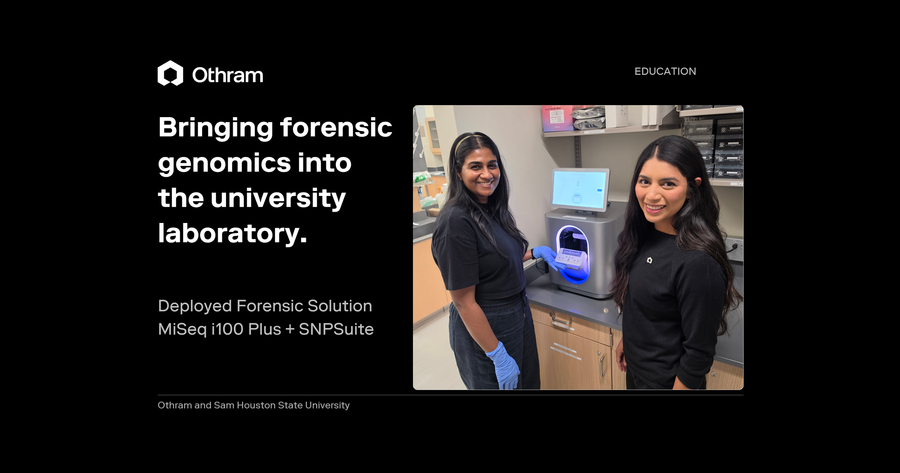
At Sam Houston State University, Othram’s collaboration brings together the MiSeq i100 Plus sequencing platform and SNPSuite to support teaching and research. SNPSuite is a cross-platform desktop application that enables Forensic Genetic Genealogy (FGG) DNA analysis to be performed locally, securely, and rapidly. Students gain access to tools that connect DNA data that are generated from biological evidence with the analysis of genetic relationships.
Dr. Sheree Hughes, Professor and Chair of the Department of Forensic Science at Sam Houston State University, describes what this makes possible:
“Through our collaboration with Othram, SHSU students are bringing forensic grade sequencing and forensic genetic genealogy from the classroom into the laboratory. Hands-on experience with the MiSeq i100 Plus and SNPsuite supports their training and research while putting emerging technologies in the hands of the scientists who will shape what comes next.”
The MiSeq i100 Plus can support a broad range of sequencing needs in academic research and teaching. At SHSU, the team sees the potential to move its full range of sequencing to the instrument, including mitochondrial sequencing, targeted SNP panels, and non-human sequencing for forensically relevant research. Alongside FGG training, these applications would give students hands-on experience with diverse sequencing methods while supporting faculty and student research across forensic science.
Students can examine the technology, investigate its limitations, and develop their own research questions. That experience prepares them to contribute to a field whose capabilities continue to grow and will be the norm of forensic genetics in the near future.
Learning to Pursue an Identity
Answering “Whose DNA is this?” requires a connected understanding of laboratory science, data quality, biological relationships, and investigative reasoning.
Students need to understand how the condition of a sample affects the information that can be recovered. They need to examine how missing data and errors influence data and kinship comparisons. Additionally, they need to distinguish between a result that suggests a relationship and the evidence required to establish an identity.
These questions become tangible when students can generate, analyze and interpret the data themselves. SNPSuite supports profile quality assessment and comparisons between individuals or against local collections of reference profiles. Its offline operation allows analysis to take place within the institution’s own computing environment.
In an educational setting, these capabilities create opportunities to follow how an unknown DNA profile can lead to a relationship hypothesis and how another comparison can strengthen, refine, or rule out that hypothesis. They can begin to ask What does the shared DNA support? Which possible relationships remain? What additional information would help distinguish between them?
Learning to ask these questions develops the scientific reasoning needed to let DNA guide an investigation. Traditional direct comparisons remain essential, while the ability to develop and evaluate identity hypotheses enables future scientists to play a broader role in helping investigations reach answers.
Supporting Institutions at Any Scale
SHSU illustrates one configuration. Othram can help universities, core facilities, and public laboratories bring these capabilities into their own environments at any scale.
An academic department may focus on student access, fundamental curricula, and graduate research. A core facility may support multiple groups with different applications and sample volumes. A public laboratory may be expanding its capabilities around operational and casework requirements.
Each setting calls for an approach suited to its goals. While the MiSeq i100 Plus is an excellent fit for academic groups, our support extends across different instrumentation, throughput requirements, and levels of existing experience.
Othram can help institutions bring together hardware, laboratory methods, analytical software, and the support putting them into practice. Othram works with teams establishing a new capability as well as those expanding on what they already do.
Prepare Students for the Challenges Ahead
The next generation of forensic scientists should be prepared to embrace the molecular biology tools of the 21st century. The costs are no longer out of reach for fundamental academic training or required research studies. For future forensic scientists that will employ FGG tools, they can learn how to evaluate a proposed match and to help discover whose DNA was left behind.
Giving students access to modern forensic genomics allows them to explore that broader responsibility while they are learning to ask better questions, test their reasoning, and help develop the methods that will move the field forward.
If you want to bring forensic sequencing and SNP analysis into your university, core facility, or public laboratory, reach out to Othram. Othram can help you select and implement the tools, methods, and training appropriate for your goals, at any scale.
Tell us what you want your students, researchers, or laboratory to accomplish. Othram will help you get started and support you as needed.