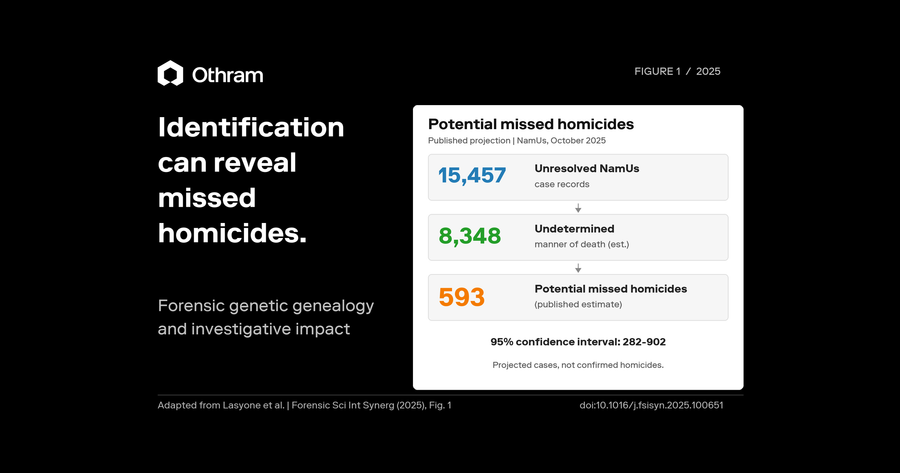
There are more than 15,000 unidentified human remains (UHR) cases listed in NamUs and this is likely a substantial underestimate of the total number of UHR cases in the United States. Traditional forensic methods, including STR testing, often rely on reference samples from known relatives, leaving many of these cases unresolved when no such references exist. For the first time, however, forensic genetic genealogy (FGG) offers a path forward. By analyzing hundreds of thousands of DNA markers, FGG can identify next of kin and trace familial relationships even in the absence of a known reference. But to unlock the potential of FGG, investigators must first obtain DNA from the remains themselves and in many cases, that requires exhumation.
What is Exhumation?
Exhumation—the legal and scientific recovery of buried human remains—is a meticulous and sensitive procedure in forensic investigations. To exhume is to return to the ground where a story was once laid to rest or a person(s) story line has not been filled in and, through careful analysis, allow that story to continue. Exhumation is a technical process and an honorable act, and must be done with respect. It is another forensic science avenue to seek truth, accountability, and human identification.
What Exhumation Means in Forensic and Anthropological Contexts
The terms “exhumation” and “disinterment” are often used interchangeably. While both terms refer to the removal of a deceased body from its original burial place, the legal process and initiating authority can vary between jurisdictions. Disinterment generally occurs when human remains are moved (or cremated) at the request of next-of-kin or for practical reasons (e.g., relocation of burial(s) from one cemetery location to another). Exhumation refers to the court-ordered removal of human remains from a burial environment for the purpose of examination, identification, or relocation. Within the field of anthropology, exhumation represents a unique intersection between biology, archaeology, and culture. From a forensic science perspective, it is an opportunity to obtain samples to reconstruct a crime and/or for human identification purposes.
Whereas archaeologists recover remains to understand past civilizations and historical events, forensic anthropologists do so to answer contemporary questions including those pertaining to identity, cause and manner of death, and the implications of burial context on circumstances of death or postmortem events.
The Scientific and Legal Framework
Exhumations require formal authorization. Typically, a court order, Medical Examiner or coroner’s directive, or written consent from next of kin is required. Health departments may require notification, and cemetery authorities must approve the procedure to ensure public safety and legal compliance. The exhumation and repatriation of the remains of foreign nationals adds an additional layer to the process and requires coordination with foreign consulates and other entities and individuals.
Once permission is granted, a multidisciplinary team—often including forensic anthropologists, forensic pathologists, law enforcement officials, and cemetery personnel—develops a recovery plan. While exhumation planning is context and jurisdiction dependent, a plan should address site conditions, resources (and especially personnel), necessary equipment, chain of custody for evidence, and protocols for respectful handling, transport and storage of the remains.
Implementation of the Exhumation Process in Forensic Casework
Whether you take on the exhumation process yourself, or work with a partner like Othram, there are some important steps to consider before you start:
- Form a team and acquire necessary resources: The team should be properly staffed, if possible, with a forensic anthropologist(s), forensic pathologist(s), law enforcement officials, and cemetery personnel. They should have all the tools at their disposal to carry out an exhumation, handle and transport the human remains, and document the process.
- Preliminary Assessment: The team should review burial records, maps, or other documents to locate the precise location of the grave. In complex or unmarked sites, ground-penetrating radar, magnetometry, or soil probing may be used to locate the presence and depth of a burial. Land surveyors or other qualified individuals may be called in to measure and map the land using precision instrumentation. Additionally, personal accounts may direct the team to a burial site(s), such as might occur for exhumation of war dead.
- Site Preparation and Documentation: The excavation area is cordoned off or tented for privacy and security. Prior to any digging, the site is assessed which may include photographs, measuring, mapping, and sketches. This documentation—from headstone placement (or absence) to nearby vegetation—may provide contextual clues, particularly when little to no other information is available. Photographs of the cemetery and general location of the grave also may be useful documentation for context of the event.
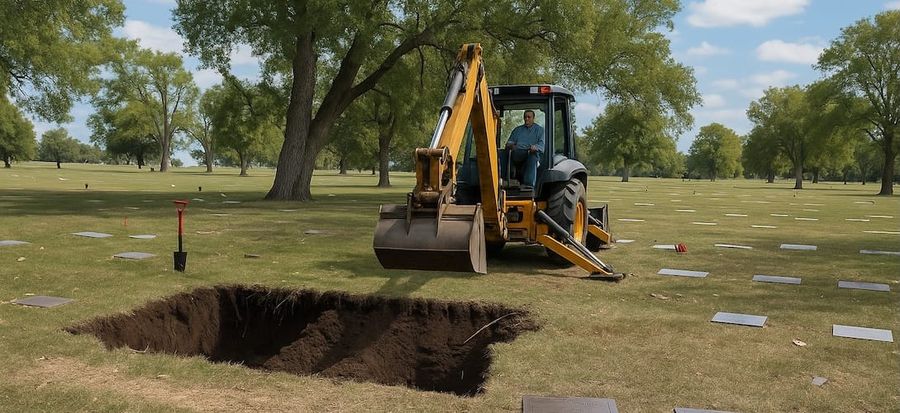
- Controlled Excavation: The exhumation may be conducted by professional cemetery personnel operating heavy machinery to remove the top layers of dirt. Alternately (or concurrently), an exhumation may be conducted archaeologically, meaning soil is removed in carefully measured layers using hand tools rather than heavy machinery. Depending on burial context, an anthropologist may record stratigraphic data and note changes in soil texture or color, all of which may indicate coffin outlines or burial disturbance.
- Recovery of Remains and Associated Artifacts: Once the remains are exposed, their position, orientation, and condition are carefully documented. If present, clothing fragments, personal effects, and coffin materials are recovered as evidence. Each item’s spatial relationship to the body is recorded to preserve contextual integrity, a key principle in forensic recovery and important to subsequent analyses.
- Post-Exhumation Analysis: If additional examination of the recovered remains is necessary, the remains are transported to a secure facility (e.g., forensic laboratory). There, forensic anthropologists and/or forensic pathologists may conduct detailed examinations to estimate a biological profile (age, sex, ancestry, and stature), assess trauma or pathology, and/or determine postmortem interval, as applicable. If the human remains are unidentified or identified and designated a person of interest in an unsolved crime, features, such as prosthetics, odontology, personal effects, isotopes, and/or DNA, are collected to assist in identification. DNA testing and/or stable isotope analyses can help determine or confirm identity or trace geographical or bioancestral origin or history. Extremely poorly preserved remains may be sampled in situ (i.e., without removing them from the grave) to prevent further damage to the bone. This type of sampling requires excavating the dirt above the burial container so the remains may be directly accessed, sampled before the container is re-sealed and then the dirt replaced.
- Reporting and Reinterment: Unless authorities determine otherwise, the remains are reburied or transferred according to terms outlined in court orders and/or family wishes. All findings related to the recovery and subsequent examination are compiled into a comprehensive case file and the findings reported for legal purposes.
Each exhumation must balance the needs of society and individuals with ethical responsibilities. Scientists, law enforcement, the criminal justice system, the affected parties, and society must balance the pursuit of evidence and justice with respect for the individual.
Othram's Professional Services for Anthropology
Othram is the leader in forensic genetic genealogy but our team can also assist with the exhumation process. If exhumation is a bottleneck in your case, Othram can provide assistance in anthropological investigations, case management, and communication to stakeholders:
- Manage the complex logistical and legal processes involved in unearthing human remains in a forensic context, particularly as it pertains to sampling biological material for purposes of Forensic-Grade Genome Sequencing® and forensic genetic genealogy.
- Facilitate procurement of, or directly obtain, the necessary legal permits, court orders, and licenses from relevant government, health, and cemetery authorities.
- Coordinate the entire exhumation and repatriation process, including securing, as applicable, the necessary facilities, specialized equipment, transportation, and staff.
- Oversee site processes to ensure all are conducted with respect and adherance to technical, safety, and evidentiary standards.
- Properly document and inventory remains and personal items and/or burial context which are critical for legal (e.g., maintaining chain of custody, adjudication of case) and family advocacy purposes.
- Act as a stakeholder liaison between law enforcement, forensic experts, and other agencies.
Othram provides high quality services that cover all aspects of anthropology, genetic analyses, and forensic genetic genealogy. Our turnkey approach and anthropological and forensic science expertise contribute to relieving time and staffing resources so an agency can focus on facilitating investigative processes as well as obtaining funding support.
Reach out now to get started with your case.