For many families, the story of a Marine who never returned home is unresolved. As decades pass, records scatter, surnames shift, relatives relocate, and branches of family trees get lost. Reconstruction of accurate family lines becomes increasingly complex, yet this work remains central to the United States Marine Corps’ commitment to account for those who served and to provide families with long-awaited clarity.
Othram has been selected by the Marine Corps to support this mission of bringing resolution to Marine Corps families through professional genealogical research, sensitive family outreach, and the preparation and logistics of DNA reference collection kits. The project blends historical rigor with thoughtful human engagement. By combining modern research tools with credentialed genealogical expertise, Othram aims to help resolve cases that have remained unanswered for decades or even generations.
Have You Been Contacted by Othram Genealogists?
If you have been contacted by an Othram genealogist, it is because historical research suggests that you may be related to a Marine who gave his/her life to defend pour country but has yet to be identified. Othram is assisting the Marine and Family Programs Division by identifying and reaching out to potential relatives who may be able to contribute to this identification and repatriation mission. The outreach process is respectful, voluntary, and confidential. You are not required to participate, and you are encouraged to ask questions and become informed before making any decision.
You may have been contacted by phone, email, or mail. Othram genealogists will explain the purpose of the call, provide information about the Marine Corps program, and answer any questions you may have about what participation involves. If you choose to assist, you may be asked to provide a brief family history conversation or to provide a DNA reference sample using a simple cheek swab kit. Othram assembles these kits using government-approved components and tracks each step to ensure safe delivery to the Armed Forces DNA Identification Laboratory (AFDIL). These samples are used only to support the Marine Corps effort to identify missing Marines.
Families who participate play an important role in helping the Marine Corps complete its commitment to honor and account for those who served. If there are concerns about the legitimacy of the outreach, you may contact the Marine and Family Programs Division or Othram directly for verification.
A Comprehensive Genealogical Workflow
The Marine Corps project begins with detailed genealogical research conducted by credentialed professionals certified through ICAPGen and the Board for Certification of Genealogists. These genealogists review military records, casualty files, census entries, vital records, obituaries, land and probate documents, and other publicly accessible historical sources that help trace family lines across many generations. Their objective is to identify the closest living maternal relatives for mitochondrial reference samples and/or paternal relatives for Y-DNA reference samples, who also are relatives that can serve for comprehensive genetic testing, when appropriate.
This research often involves complexities that extend beyond standard record lookup. Many of the documents involved may contain incomplete entries, contradictory information, or handwritten details that require careful evaluation. Family structures may also vary in ways that are not reflected in surviving records. Genealogists correlate information across multiple sources, resolve conflicting information, and construct a defensible genealogical narrative. All completed research undergoes peer review by a second credentialed genealogist before any outreach begins. This internal quality assurance step helps ensure adherence to the Genealogical Proof Standard.
Once genealogical conclusions have been verified, Othram’s outreach team contacts identified relatives. Staff rely on trauma-informed communication practices that recognize the emotional and historical weight these cases may carry. Every outreach attempt is documented to support transparency and has Marine Corps oversight. When relatives agree to participate, Othram prepares, ships, and tracks DNA reference collection kits, ensuring they reach AFDIL promptly and securely.
The Role of Othram Maps in Large Scale Genealogical Projects
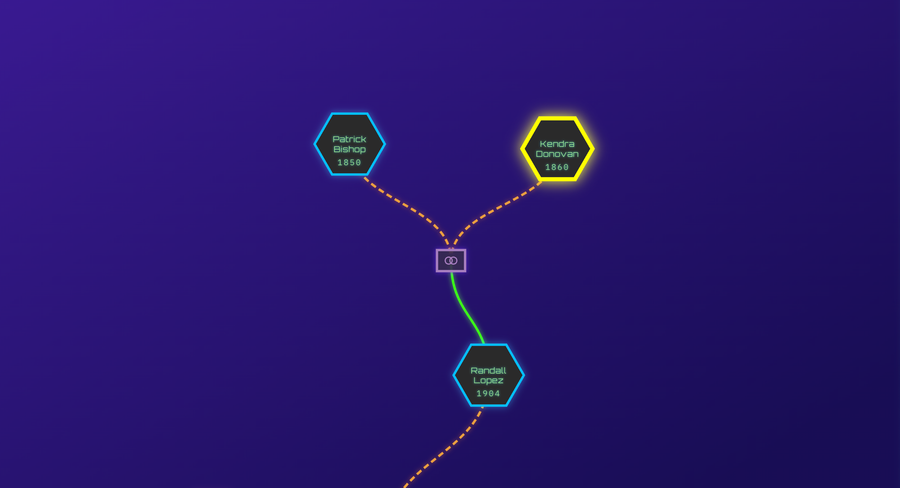
Large projects involving historical and military genealogical research require tools that help organize and interpret complex family relationship structures. Traditional family trees can become difficult to manage when dozens of individuals and several generations are involved. Othram Maps offers a structured and navigable view of these relationships that helps genealogists identify gaps in documentation, understand how different records support one another, and maintain an organized research trail.

Because Othram Maps retains a clear, auditable representation of each case, it strengthens the accuracy and defensibility of genealogical conclusions. This process is particularly valuable when historical records are limited or inconsistent. For a project that may involve more than one thousand Marine Corps cases, the organization and clarity provided by tools like Othram Maps are essential to ensuring research quality at scale.
AI-Assisted Records Research with Othram GLIMPSE
Othram also built Othram GLIMPSE, an AI-assisted research tool that supports the review of historical records. Many archival materials contain handwritten information, outdated terminology, or inconsistencies that slow the research process. Othram GLIMPSE assists genealogists by highlighting potential matches, suggesting relevant record sets, and calling attention to inconsistencies that require additional investigation. This tool accelerates the review of large record sets and frees genealogists to focus on analysis and interpretation rather than manual document sorting.
Othram GLIMPSE enhances efficiency but does not replace essential professional judgment. It helps ensure that no relevant detail is overlooked during the investigation of complex historical cases. This support is particularly valuable in a large project where timely and consistent research is essential.
Accuracy, Compassion, and Accountability for All
Every aspect of the Marine Corps project is designed to combine genealogical accuracy with respectful engagement. Individuals contacted by Othram may be learning new information about a relative who served many decades ago. Othram’s outreach procedures prioritize clarity, respect, and transparency. Genealogical work and family communication occur within a secure case management environment that protects personal information and thus supports Marine Corps oversight.
Although this effort centers on genealogical reconstruction and reference-kit logistics rather than DNA sequencing, the work establishes the foundation upon which scientific identifications can be performed by federal laboratories. Accurate genealogical conclusions and properly collected reference samples help ensure that identification efforts proceed smoothly and reliably.
Looking Forward
The Marine Corps has more than one thousand individuals to evaluate in this effort and addressing such a large volume of historical cases requires a scalable research framework. Othram brings credentialed genealogical expertise combined with tools that support high-volume archival research, AI-assisted document review, and organized visualization of family structures. As this project progresses, Othram will continue refining its methods and sharing insights that contribute to best practices in historical and humanitarian genealogy. By maintaining a focus on accuracy, compassion, and operational discipline, Othram aims to support the Marine Corps in fulfilling its long-standing commitment and tradition to account for those who served.
If your agency is looking to incorporate genealogy or genetic genealogy into your workflow, reach out to Othram. We provide testing services, collection kits, DNA analysis tools, and purpose-built genealogy software, offering everything you need to solve your case.