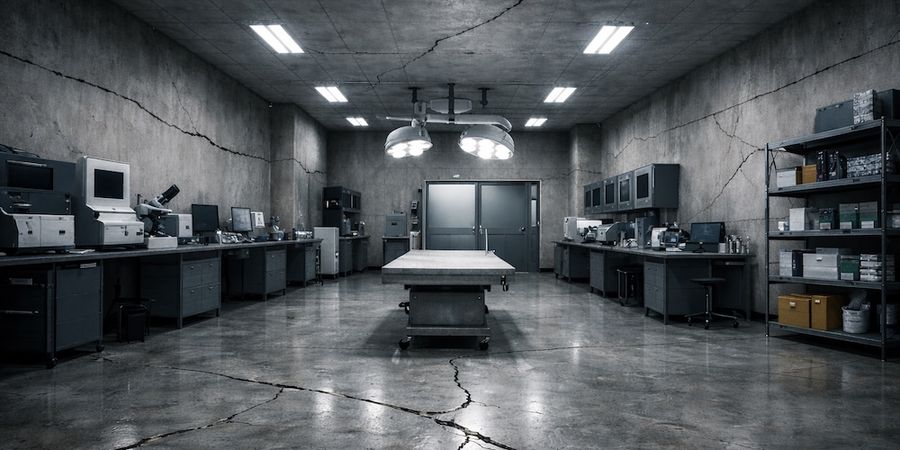
Recent reporting on the crisis in forensic science in the United Kingdom has renewed concerns about the integrity of criminal justice systems. Fifteen years ago, the UK dissolved the Forensic Science Service (FSS), a decision that prompted significant concerns about the future of forensic capability and investment. At the time, there were warnings that without sustained reinvestment in scientific capacity and innovation and proper operationally accountable models, the system would become increasingly fragile.
Warnings of rising miscarriages of justice, lost evidence, and brittle forensic conclusions are alarming, but they are not surprising. The situation unfolding in the United Kingdom is not an isolated failure, nor is it solely the result of a single policy decision. It is a visible example of a broader, global pattern that has continued for years.
In many jurisdictions, forensic science is not treated as a critical national infrastructure. Instead, it has been managed as a cost-constrained service, vulnerable to short-term decision-making, fragmented oversight, and chronic underinvestment in technology and scientific capacity. When forensic science degrades, justice systems do not simply slow down. They begin to fail, and most importantly victims, families, and innocent people pay the price.
Governance failures are real, but they are not the root cause
Critiques of failed forensic systems often focus on governance: the absence of clear ministerial ownership, the dismantling of public forensic institutions, shortcomings in procurement models, or weak management structures. These critiques are valid and important. However, they largely describe how systems failed, not why those failures recur across jurisdictions.
When forensic science lacks sustained public accountability and long-term ownership of outcomes, investment predictably collapses or never materializes in the first place. Procurement cycles shorten. Research funding becomes episodic. Training degrades. Technology refreshes are deferred. Scientific independence erodes. The system shifts away from capability building and toward short-term cost control.
Governance failures are best understood as mechanisms that accelerate decline, but do not address the underlying cause(s). The deeper issue is that forensic science has been allowed to operate without a proper investment model that reflects the foundational role of the discipline in supporting outcomes of determining guilt, innocence, and identity within the justice system.
Without sustained investment in technology, independent scientific capacity, and modern methods, no governance structure—public or private—can effectively prevent forensic failure or the downstream risk of miscarriages of justice.
Forensic science was treated as a service, not a scientific discipline
Forensic science occupies a unique position among scientific disciplines. It is simultaneously operational, scientific, legal, and an engine for community awareness and confidence in its government(s). Yet in many jurisdictions, forensic science has been treated primarily as a transactional service, purchased case-by-case and evaluated largely on price and turnaround time. Under this paradigm quality suffers.
This approach incentivizes the preservation of legacy methods, manual workflows, narrowly scoped validations and inadequate training of personnel. It discourages investment in modern computational approaches, robust statistical frameworks, technologies designed for degraded or complex evidence, and most of all its most important asset which is people. Over time, the scientific capacity of the system stagnates and worse declines.
The result is brittle forensic output. Conclusions may appear definitive. But they may be built on fragile assumptions and incomplete data which at times may be unsupportable. When these conclusions are stress-tested, whether by judicial proceedings, appeals, or new evidence, the weaknesses may become apparent. This brittleness is a direct contributor to miscarriages of justice and loss of confidence by the public and oversight ministries.
The collapse of academic forensic science is a global pattern
Independent forensic science research and validation should serve as a stabilizing and energizing force within the forensic ecosystem. This work has traditionally occurred initially within law enforcement agencies and has progressed in the end of the 20th Century through today more so to universities and industry, but it is not inherently tied to any single institutional setting. What matters is the existence of sustained, independent scientific capacity to challenge assumptions, evaluate methods, and develop new analytical frameworks under real-world constraints.
Across jurisdictions, this innovative capacity and commitment have eroded. Access to contemporary forensic data is limited. Funding for translational research, large-scale validation studies, and systematic failure-mode analysis is scarce. Whether housed in academic institutions, public laboratories, private entities, or independent research programs, the scientific work required to validate and advance forensic inference has not been prioritized as an overarching need as a critical component of the justice system.
As a result, the feedback loop between casework, data, and scientific evaluation has weakened or disappeared entirely. Methods age without being stress-tested against modern evidence and systems requirements. Error modes remain poorly characterized. Operational practice evolves without parallel scientific scrutiny.
This issue is not a problem of geography or institutional form. It is a problem of investment and prioritization. The erosion of independent forensic science capacity is a global pattern, and its absence removes one of the few mechanisms capable of correcting error and advancing forensic inference over time.
Police in-housing is a reaction to technology failure, not a solution
The expansion of out-sourcing forensic capabilities by police agencies in the United Kingdom was cited as evidence of systemic failure. In reality, it was a seemingly rational response by the police to unmet operational needs: speed, control, and predictability.
However, solely mandating out-sourcing overcame a logistical constraint, but neglected scientific issues and training of personnel. Without parallel investment in technology development, independent validation, research, personnel and education, systems risk entrenching outdated methods and unprepared staff behind organizational walls. Quality diminishes, innovation slows, and long-term risk increases.
This critique is not questioning the intent of the decisions made. It raises awareness that system design must be evaluated. When technology stagnates and training and knowledge degrade, institutions compensate operationally, often at the expense of scientific robustness.
Why this crisis is universal, not jurisdiction-specific
These same structural feature deficiencies appear repeatedly across jurisdictions: fragmented oversight, short-term funding models, weak academic pipelines, and limited investment in modern forensic technology and training. These conditions are not unique to any one system, they are pervasive.
Justice systems worldwide depend on forensic evidence to help identify the guilty, exonerate the innocent, and provide answers to victims, families, communities and sectors of government. Yet the scientific infrastructure supporting those results is routinely underfunded relative to its impact.
This disconnect contributes to why similar failures continue to emerge, irrespective of whether forensic services are public, private, or public-private operations.
Treating forensic science as infrastructure, not a commodity
Infrastructure and quality thinking change priorities. They emphasize reliability, resilience, auditability, and long-term performance. Applied to forensic science, this means sustained investment in technology, training, independent scientific capacity, modern statistical frameworks, end-to-end system design, and quality.
Forensic infrastructure must be built to first and foremost provide quality results, embrace validated technologies that provide state-of-the-art capabilities, withstand legal scrutiny, scale across case types, and adapt, when feasible, to the evolving demands to analyze ever increasing request to analyze challenging evidence. This desired level cannot be achieved through short-term procurement or isolated reforms.
Technology investment is a justice imperative
The crisis in forensic science is not fundamentally a failure of private companies, individual government agencies, or isolated policies. It is the predictable outcome of abandoning forensic science as a scientific discipline and national asset.
When forensic science fails, justice fails. Preventing miscarriages of justice requires more than oversight and regulation. It requires sustained investment in technology, research, training, and systems designed for truth-seeking rather than prioritizing cost containment and turnaround time.
Treating forensic science as infrastructure is not optional. It is a prerequisite for a functioning justice system. Othram is working to build better infrastructure for forensic science, designed for reliability, validation, and long-term outcomes. Whether through direct casework collaboration or by enabling laboratories to deploy modern forensic workflows independently, we are committed to supporting systems that deliver durable and defensible justice outcomes.
Reach out to our team to get started.